
Article: Lip Balm vs Chapstick: Which One Should You Choose?
Lip Balm vs Chapstick: Which One Should You Choose?
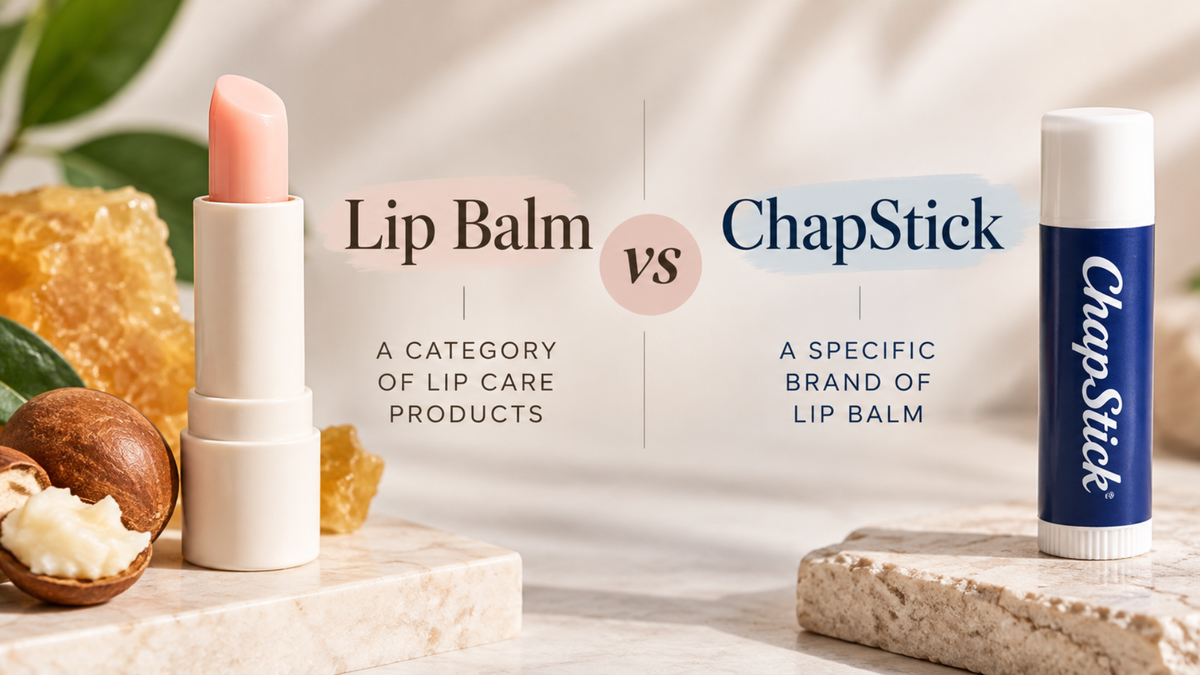
The short answer: Lip balm is the product category. ChapStick is one brand inside that category. Every ChapStick product is a lip balm, but most lip balms are not ChapStick. The comparison that matters is not brand against brand, it is formula against formula, because the ingredients and their concentrations decide what a lip product actually does.
This article covers what each term means, what ChapStick products do and how they work, what different formulas contain, why some ingredients can worsen dry or chapped lips for certain people, and how to choose based on your lips rather than the label.
Lip Balm vs ChapStick: Key Takeaways
-
Lip balm is the broad product category. ChapStick is a specific lip-care brand.
-
Different formulas can behave differently, even within the same brand and the same product name.
-
Ingredients matter more than the name on the package.
-
"Natural," "vegan," and "gentle" are not the same claim as "irritant-free."
-
The best lip product depends on your needs, the formula, and your individual tolerance.
Lip Balm vs Chapstick: What's the Difference?
The difference is one of scope. "Lip balm" names a category of products. "ChapStick" names a single brand that makes products in that category.

It is the same relationship as "bandage" and "Band-Aid," noting that "chapstick" is commonly used to describe a wide range of lip products rather than one specific product or brand. Because ChapStick has become widely used in everyday speech as a generic term for lip balm, people often use "chapstick" to refer to lip-care products from other brands entirely. So "lip balm vs chapstick" is not a matchup between two competing products. It is a matchup between a category and one member of it.
What Is Lip Balm?
Lip balm is a broad term for topical products applied to the lips to protect them, soften them, and help them retain moisture. The category covers waxy sticks, salves, thicker ointments, tinted treatments, and gloss-style balms.
The purpose is shared. The formula is not. Products are usually grouped by intent:
-
Protective balms that form a barrier and help reduce moisture loss
-
Conditioning balms with oils and butters that improve how the surface feels
-
Treatment-style balms combining occlusive, emollient, and humectant ingredients
-
Medicated balms with actives such as camphor, menthol, or phenol
-
SPF balms for outdoor use
-
Tinted balms and treatment glosses that add color or shine
What Is ChapStick?
ChapStick is a specific lip care brand with roots in the early 1880s. The range includes Classic sticks, a Medicated formula, moisturizing and Total Hydration products, tinted options, and formulas with sun protection.
Because the brand became a household word, people use "chapstick" lowercase for any lip balm, including products from other companies. That habit is convenient in conversation and confusing while shopping. Someone who says "chapstick" may mean a 45 percent petrolatum stick, a beeswax balm, a tinted gloss, or a medicated product with phenol in it. Those are not interchangeable.
ChapStick ownership changed in 2024. Haleon announced the sale of the ChapStick brand to Suave Brands Company, a portfolio company of Yellow Wood Partners, in January 2024, and completed the disposal on 31 May 2024 for pre-tax cash proceeds of approximately $430 million plus a passive minority interest in Suave Brands Company.
Is Lip Balm the Same as ChapStick?
No. ChapStick is a brand, and lip balm is the category it belongs to. All ChapStick products are lip balms, the way all Band-Aids are bandages. The reverse is not true. Carmex, Vaseline, Aquaphor, Burt's Bees, and hundreds of other brands make lip balms, and none of them are ChapStick.
Comparing "lip balm" to "ChapStick" compares a category to a brand. Comparing formulas tells you how a product will actually behave.
Lip Balm vs ChapStick at a Glance
| Feature | Lip Balm | ChapStick |
| What it is | Product category | Brand name |
| How many exist | Dozens of brands, hundreds of formulas | One brand with multiple product lines |
| Main purpose | Depends on the formula | Depends on the specific product |
| Typical base | Petrolatum, waxes, oils, butters, or a blend | Petrolatum and wax base in the Classic line |
| Humectants | Some formulas include them | Varies by product |
| SPF, tint, medicated options | Widely available across brands | Some products in each category |
| Ingredient transparency | On the label or brand site | On the label or DailyMed |
The key takeaway: the name on the tube tells you less than the ingredient list.
Brand tells you who makes it.
Formula tells you what it contains.
Ingredients help explain how it behaves.
Your response determines whether it works for you.
What Does ChapStick Do?
Some ChapStick formulations are marketed in the United States as over-the-counter skin protectants, while other products in the range are cosmetic lip-care products. The specific product label matters. For the OTC products, the labeled purpose is to help prevent and temporarily protect chafed, chapped, or cracked lips, and to help protect against the drying effects of wind and cold weather.
In plain terms, a ChapStick product:
-
Protects the lips by placing a physical layer over the lip surface
-
Helps reduce moisture loss rather than adding water to the lips
-
Helps soften the lip surface so it feels smoother and more comfortable
-
Creates a barrier against wind, cold, and dry air
-
Adds functions depending on the formula, such as sun protection, temporary cold sore pain relief, color, or flavor
The Medicated formula is labeled for temporary relief of pain associated with fever blisters and cold sores because it contains camphor and menthol as external analgesics. A plain Classic stick carries no such claim. Same brand, different job.
How Does ChapStick Work?
For a basic protective lip balm, the primary action is physical: the formula sits on the lip surface and helps reduce moisture loss. Medicated formulas can also have specific pharmacological effects from their active ingredients, which is why a medicated balm can cool, soothe, or temporarily relieve pain in a way a plain petrolatum stick does not. Three ingredient classes do most of the work.

Occlusives
Occlusives form a film that water has difficulty crossing, so the lips lose moisture more slowly than they would if bare. Petrolatum is the most studied occlusive in skin care. The American Academy of Dermatology notes that for very dry or cracked lips, a thick ointment such as white petroleum jelly works better than a thin balm because an ointment seals in water longer than waxes or oils do. Waxes can contribute structure and a protective film to a lip-balm formula.
Emollients
Emollients make lips feel soft. They smooth the surface and fill gaps between flakes of dry skin, reducing the rough, tight feeling that comes with chapping. Typical examples include castor and sunflower seed oils, shea and cocoa butters, and esters such as isopropyl myristate. Emollients also shape how a formula spreads and how long it stays comfortable.
Humectants
Humectants help attract and retain water in the outer layers of the skin. Their performance depends on the surrounding formula and on environmental conditions, which is why they are often combined with emollients and occlusives in moisturizing products rather than used on their own. Sodium hyaluronate and glycerin are common examples.
Why Formulations Behave Differently
The variables are which ingredient classes are present, at what concentration, and in what base.
ChapStick Classic Original and ChapStick Classic Medicated are both marketed as Classic products, yet their labels show different active ingredient profiles and different inactive ingredient lists. Concentration matters as much as presence, and the same product name can appear under more than one current label, which is discussed in the next sections. That is the mechanical reason "which lip balm is best" has no universal answer.
What Is ChapStick Made Of?
There is no single ChapStick formula. Ingredients vary between products and can change over time, including changes of ownership and formulation updates.
Occlusive ingredients form the barrier layer: petrolatum, the active in the Classic skin protectant products, plus mineral oil, waxes such as paraffin, beeswax, and carnauba wax, and silicones such as phenyl trimethicone.
Emollient ingredients soften and condition: plant oils, butters such as shea and cocoa butter, esters such as isopropyl myristate, and fatty alcohols such as cetyl and oleyl alcohol, which condition rather than dry.
Humectant ingredients attract and hold water, including sodium hyaluronate and glycerin. Many traditional stick balms contain none at all, which is one clear structural difference between a basic protective balm and a treatment formula.
Functional ingredients do something beyond moisturizing: sunscreen actives such as zinc oxide or octinoxate, analgesics including camphor, menthol, and phenol, flavoring and fragrance, colorants, and antioxidants and preservatives such as tocopherol.
What the Ingredient Lists Reveal: 5 Popular Lip Balm Formulas Compared
Labels are the most useful and least used tool in the lip care aisle.
How we compared them: we reviewed the published ingredient lists and product labels available at the time of publication. Ingredient functions are generalized by formulation role and do not predict individual skin reactions.

| Product | Occlusives | Emollients | Humectants | Potential irritants or sensitizers | SPF and actives |
| ChapStick Classic Original (DailyMed label, updated March 2026) | White petrolatum, paraffin, mineral oil, beeswax, carnauba wax, phenyl trimethicone | Octyldodecanol, arachidyl propionate, oleyl alcohol, isopropyl lanolate, isopropyl myristate, cetyl alcohol, lanolin | None listed | Camphor, lanolin, flavor | No SPF. White petrolatum as skin protectant. Titanium dioxide appears as a colorant, not a sunscreen active. |
| ChapStick Classic Medicated (DailyMed label with phenol) | Petrolatum 41%, light mineral oil, paraffin, white wax, carnauba wax | Cocoa butter, cetyl alcohol, isopropyl myristate, lanolin, octyldodecanol | None listed | Camphor 1%, menthol 0.6%, phenol 0.5%, fragrance, lanolin | No SPF. Camphor, menthol, and phenol as external analgesics. |
| Carmex Original Stick | White petrolatum 35%, paraffin, ozokerite, candelilla wax, beeswax | Lanolin, cocoa butter, meadowfoam seed oil, cetyl esters | None listed | Camphor, menthol, phenol, salicylic acid, flavor, lanolin | SPF 15 from octinoxate 7.5% and oxybenzone 4%. |
| The Earthling Co. Peppermint Lip Balm | Candelilla wax, bayberry fruit wax | Sunflower seed oil, coconut oil, shea butter, cocoa butter, mango butter, pomegranate sterols | None listed | Peppermint oil, flagged in dermatology guidance as a flavoring that can irritate dry, chapped lips | No SPF. |
| Goldn Beauty Lip Silk Bare | Microcrystalline wax, mineral oil, hydrogenated polydecene, polyisobutene | Bis-diglyceryl polyacyladipate-2, diisostearyl malate, caprylic/capric triglyceride, castor seed oil, shea butter, C12-15 alkyl benzoate | Sodium hyaluronate | Fragrance, sodium saccharin | No SPF. Peptides and tocopheryl acetate listed. |
A note on the "potential irritants or sensitizers" column. Listing an ingredient here does not mean it will cause a reaction in everyone. Individual tolerance varies, and published dermatology guidance about these ingredients often applies specifically to already-irritated or chapped lips. DermNet documents allergic and irritant contact reactions from lip-care ingredients, but that does not mean every person reacts to every listed ingredient.
Ingredient lists can change. The comparison above is based on the product labels and ingredient lists available at the time of publication. Check the package or current manufacturer information before purchasing.
Three things stand out.
One brand is not one formula, and sometimes not even one product name. The current DailyMed record for ChapStick Classic Original lists camphor, lanolin, and flavor, and does not list fragrance. Meanwhile, two different current DailyMed records exist for ChapStick Classic Medicated: one lists camphor 1%, menthol 0.6%, petrolatum 41%, and phenol 0.5%, and another lists camphor 1.6%, menthol 0.6%, and white petrolatum 41% with no phenol. Anyone who says "ChapStick dries your lips" or "ChapStick is fine" is making a claim about a brand that behaves like several different products.
"Natural" is not the same as "irritant-free." The Earthling Co.'s peppermint balm is vegan, petroleum-free, and built from plant butters and waxes, and it contains peppermint oil. Peppermint and mint flavorings sit on the American Academy of Dermatology's list of ingredients to avoid while lips are chapped, and peppermint oil has been documented as a cause of allergic contact cheilitis in a published case series of lip balm users.
Humectants are rare in traditional stick balms. Only one product here lists one. If your concern is hydration rather than plain protection, that is the column to check.
Does ChapStick Dry Out Your Lips?
No, not automatically, and not because of the brand. Different ChapStick formulas contain different ingredients, and some of those ingredients may irritate certain people, particularly when lips are already chapped. A balm that works normally reduces moisture loss. A balm that does not work for you can create the impression that it is drying your lips out.
Does ChapStick Make Your Lips More Chapped?
It can, for some people, with some formulas. This is not a claim about ChapStick specifically. It applies to any lip product containing ingredients the user reacts to, and the mechanism is a documented loop.
Lip balms containing ingredients such as phenol, menthol, and salicylic acid can dry out lips, so people apply more, creating a cycle. She notes that fragrances, added flavorings, and artificial colors can also irritate the skin or trigger allergies.
The AAD recommends avoiding products containing camphor, eucalyptus, flavoring such as cinnamon, citrus, mint, and peppermint, fragrance, lanolin, and menthol while lips are chapped, and advises stopping any product that causes burning, stinging, or tingling. Cleveland Clinic's cheilitis overview lists a similar set, including fragrances and flavoring, lanolin, menthol, eucalyptus, and camphor.
Several factors decide whether this happens to you: the specific formula and concentrations, your individual sensitivity, the condition of your lips, environmental factors such as cold and dry indoor air, and habits such as licking your lips, which the AAD notes worsens dryness because saliva evaporates.
One belief worth setting aside: lips cannot become physiologically dependent on lip balm. Medical dependence does not occur, though frequent application can become a comforting routine. If you feel you constantly need more, the likely explanations are a formula that protects poorly, a formula that irritates, or an environmental factor undoing the benefit.
Signs it may be time to switch: burning, stinging, or tingling after application; increasing irritation rather than improvement; redness, swelling, or new cracking; dryness that worsens with continued use; or no improvement after two or three days. If dryness persists for weeks, bleeds, or comes with cracking at the corners of the mouth, that warrants a dermatologist's input, since persistent lip inflammation has causes beyond simple dryness.
Is ChapStick Good or Bad for Your Lips?
For most people, most of the time, a well-chosen lip balm is helpful and safe for daily use. Whether an individual product suits you depends on its ingredients, your sensitivity, and what your lips are dealing with right now. There is no blanket verdict at the level of a brand.
When Lip Balm Can Be Helpful
Lip care products earn their place in several situations: dry lips, where an occlusive formula slows moisture loss; chapped lips, where a simple non-irritating balm supports recovery; cold and windy conditions, which the research identifies as a specific cause of dryness; everyday protection against indoor heating and air conditioning; outdoor sun exposure, where SPF 30 or higher should be reapplied every two hours; and overnight use, since applying balm before bed gives it hours of uninterrupted contact. Applying a non-irritating balm several times a day and before bed, and suggests a thick ointment such as white petroleum jelly for very dry or cracked lips.
When a Formula May Irritate Your Lips
The issue is specific ingredients and individual reactions, not fragrance or flavoring as a general category. A lightly fragranced balm is well tolerated by many people. It is also one of the more common triggers when someone does react.
The most frequently flagged ingredients in dermatology guidance are camphor, menthol, phenol, salicylic acid, eucalyptus, lanolin, and added fragrance or flavoring, particularly mint, peppermint, cinnamon, and citrus. DermNet, the clinical resource maintained by New Zealand dermatologists, lists perfume and flavoring components, lanolin, propolis, and carnauba wax among reported allergens in lip care products.
Notice the pattern. Ingredients often associated with gentle or natural formulas are not automatically tolerated by everyone. Certain lip-care ingredients, including lanolin, castor oil, coconut oil, fragrance components, and some other botanical or cosmetic ingredients, have been reported in allergic contact reactions. That does not make them harmful. It means "natural," "gentle," and "safe for your lips" are different claims, and no ingredient is universally tolerated.
Is ChapStick Bad for You?
No, and it is also not universally right for everyone. Some ChapStick formulations are marketed as over-the-counter skin protectants and are widely and safely used by most people. Others in the range are cosmetics. The Medicated formula's camphor and menthol are legitimate external analgesics, which is why that product is labeled for temporary relief of pain associated with fever blisters and cold sores.
A petrolatum-forward ChapStick is a reasonable occlusive balm. A medicated or heavily flavored one contains ingredients dermatology organizations recommend avoiding while lips are actively chapped. Neither fact makes the brand good or bad. It makes the label worth reading.
How to Choose the Right Lip Balm

For Everyday Lip Protection
Look for a solid occlusive base, typically petrolatum, a wax blend, or a silicone, plus enough emollients to make it comfortable. A simple petrolatum-based balm is a reliable default and is what both the AAD and Cleveland Clinic point toward for straightforward protection.
For Dry or Chapped Lips
Prioritize barrier strength and simplicity. The expert suggests a thick ointment such as white petroleum jelly for very dry and cracked lips. Also address causes, not just symptoms: drinking enough water, using a humidifier in dry rooms, and stopping lip licking will do more for persistent dryness than any single product.
For Sensitive or Easily Irritated Lips
Build a short list of ingredients you know you tolerate, then check labels against it. Rather than assuming fragrance-free is universally necessary, track what happens when you use a fragranced product. The AAD's rule is the clearest available: if a lip product makes your lips burn, sting, or tingle, stop using it. (American Academy of Dermatology) If you react to several products and cannot identify the trigger, a dermatologist can patch test for specific allergens.
For Sun Protection
Look for SPF 30 or higher with zinc oxide, titanium dioxide, or both. The AAD specifically recommends SPF 30 or higher using one or both of those ingredients, and advises reapplying every two hours outdoors, including in winter, since sun can burn already-dry lips and make the problem worse. (American Academy of Dermatology)
For Hydration and Conditioning
This is where the humectant column earns its keep. If your lips feel dry even when coated in product, a formula combining a humectant such as sodium hyaluronate with emollients and occlusives gives you all three mechanisms instead of one. Pair it with a heavier occlusive at night so the water a humectant attracts has somewhere to stay.
For Color and Shine
Tinted balms and treatment glosses cover two needs at once. Evaluate them by the same ingredient standards you would apply to a plain balm. Color and shine are additions to a formula, not a substitute for one.
Why Formula Matters More Than the Label
The question in this article's title is not really about brands. Both terms describe the same shelf, and one is simply broader than the other. What people are trying to work out when they search "lip balm vs chapstick" is practical: which product will help my lips and which one will not.
That question has one reliable answer, and it is on the back of the tube.
The name on the tube tells you less than the ingredient list.
Brand tells you who makes it → Formula tells you what it contains → Ingredients help explain how it behaves → Your response determines whether it works for you.
Two products in the table above carry the same product name and appear under two different current DailyMed records with different active ingredient profiles. One product marketed as natural and petroleum-free contains a flavoring that dermatology guidance flags for chapped lips. One treatment balm contains a humectant the traditional stick balms lack. None of that is visible from the front of the package.
Ingredient lists are generally arranged in descending order of predominance, although ingredients present at 1 percent or less may be listed in a different order. The list can still help you understand the formula's main components and identify ingredients you know your lips do not tolerate.
Where Goldn Beauty Lip Silk Fits In
Goldn Beauty positions Lip Silk as a conditioning lip balm and gloss hybrid designed around peptides, hyaluronic acid, vitamin E, and a rich emollient base. The range includes four shades, Bare, Minimal, Flush, and Poppy, plus a full set.
What Is Actually in Lip Silk?
The published INCI for Lip Silk Bare lists microcrystalline wax, mineral oil, hydrogenated polydecene, polyisobutene, castor seed oil, shea butter, caprylic/capric triglyceride, diisostearyl malate, sodium hyaluronate, tocopherol and tocopheryl acetate, Lactobacillus/Papaya Fruit Ferment Extract, radish root ferment filtrate, sea fennel and kelp extracts, fragrance, and sodium saccharin, plus the copolymer ingredients that give the formula its gloss and staying power. Goldn Beauty lists tripeptide-1 among the formula's peptides.
The published INCI lists fragrance. Lip Silk is not a fragrance-free formula, and anyone who knows fragrance irritates their lips should test it on a small area first. A fragrance listing does not disclose concentration or source, so it is a flag to watch rather than a verdict, but it is relevant.
The published INCI also contains Lactobacillus/Papaya Fruit Ferment Extract. Because botanical and fermented extracts can have different functions depending on the formulation, it is better to evaluate the complete formula rather than assume one ingredient determines how the product will perform on chapped lips. The AAD's general guidance is to avoid any product that irritates or stings chapped lips.
Why Goldn Beauty Uses These Ingredients
Microcrystalline wax, mineral oil, and hydrogenated polydecene form the occlusive layer that helps slow moisture loss. Shea butter, castor seed oil, caprylic/capric triglyceride, and the isostearyl esters act as emollients. Sodium hyaluronate is the humectant. Peptides, including tripeptide-1, are included for the appearance of firmer, smoother-looking lips. Tocopherol and tocopheryl acetate, forms of vitamin E, act as antioxidants. Papaya fruit ferment and radish root ferment are included for conditioning.
What Makes Lip Silk Different
The verifiable points of difference:
-
Goldn Beauty describes Lip Silk as vegan, and the published INCI does not list lanolin or beeswax. Lanolin is on the AAD's list of ingredients to avoid while lips are chapped.
-
A hyaluronic acid lip treatment rather than a plain protective stick. Sodium hyaluronate puts Lip Silk among the balms that combine all three ingredient mechanisms rather than relying on occlusives alone. If your lips feel dry even when coated, this is the structural difference that matters most.
-
A balm-and-gloss format designed to work as lip care and as a finishing layer, replacing two products with one.
-
Four shades. Bare and Minimal are near-neutral, while the tinted lip balm shade Flush and Poppy add visible color.
-
Day and night use, as described by the brand: morning application, layering over lip color, and a heavier application before bed as an overnight lip treatment.
If your priority is a simple, single-ingredient occlusive for actively cracked lips, a plain petrolatum ointment is the better tool and costs far less. If you want a daily conditioning balm that combines humectants with emollients, adds a finish you can wear alone, and does not list lanolin in the published INCI, Lip Silk fits that brief. Explore the Lip Silk collection at Goldn Beauty.
Frequently Asked Questions
Is lip balm the same as ChapStick?
No. ChapStick is one brand, and lip balm is the broader category of products designed to protect and condition the lips. All ChapStick products are lip balms, the way all Band-Aids are bandages. Most lip balms on the market are made by other brands.
What does ChapStick do?
ChapStick covers a range. Some formulations are marketed as over-the-counter skin protectants labeled to help prevent and temporarily protect chafed, chapped, or cracked lips and to help protect against wind and cold. Other products in the range are cosmetics that add color, flavor, or shine.
How does ChapStick work?
A basic balm works physically, forming a layer on the lip surface that helps slow moisture loss. Emollients soften the surface, and humectants, when present, help attract and retain water. Medicated formulas also carry active ingredients such as camphor and menthol, which produce their own effects.
What is ChapStick made of?
There is no single ChapStick formula. The current DailyMed label for Classic Original lists white petrolatum plus paraffin, mineral oil, beeswax, carnauba wax, camphor, lanolin, and flavor. Ingredients and labels vary by product and can change, so the package is the reliable source.
Is ChapStick good for your lips?
For most people, a petrolatum-based ChapStick is a reasonable everyday protective balm and safe to use daily. Whether a specific product suits you depends on its ingredients and your sensitivity. Formulas containing camphor, menthol, phenol, or added fragrance may not be the best choice while lips are chapped.
Is ChapStick bad for your lips?
No, not categorically. ChapStick products are widely and safely used, and some are regulated over-the-counter skin protectants. That said, dermatology organizations recommend avoiding certain ingredients, including camphor, menthol, eucalyptus, lanolin, and added fragrance or flavoring, while lips are chapped. That applies to any brand.
Does ChapStick dry your lips?
Not automatically. A well-chosen balm helps reduce moisture loss rather than causing it. If a specific product feels drying, the likely cause is an ingredient you are reacting to rather than the category itself. Stopping that product and switching to a simpler formula usually resolves it.
Can ChapStick make your lips more chapped?
It can for some people with some formulas. Ingredients such as phenol, menthol, and salicylic acid are associated with drying lips further, and fragrance, flavoring, and other ingredients can trigger irritation in sensitive individuals. If a balm causes burning, stinging, or tingling, the guidance is to stop using it.
Can I use lip balm every day?
Yes. Daily use is safe, and lips cannot become physiologically dependent on lip balm. Guidance is to apply a non-irritating balm several times a day and before bed, and to reapply SPF lip products every two hours outdoors. Frequent reapplication is only a concern if it signals the formula is not working.
What is the difference between lip balm and lip gloss?
Lip balm is formulated mainly to protect and condition the lips. Lip gloss is formulated mainly for shine and finish, and it may or may not contain conditioning ingredients. The two categories now overlap, and treatment glosses combine both functions in one product.
What ingredients should I look for in a lip balm?
For protection, look for occlusives such as petrolatum, waxes, or dimethicone, plus emollients such as shea butter or plant oils. For hydration, look for a humectant such as sodium hyaluronate or glycerin. For outdoor use, look for SPF 30 or higher with zinc oxide or titanium dioxide.
The Bottom Line
ChapStick is a brand. Lip balm is the category it belongs to. That is the whole of the difference between the two words, and it is smaller than most people expect when they start comparing them.
What is genuinely different, product to product, is the formula. Current DailyMed records show two different active ingredient profiles under the same ChapStick Classic Medicated name. A plant-butter balm marketed as natural contains peppermint oil, which dermatology guidance flags for chapped lips. A conditioning treatment gloss contains a humectant the traditional stick balms lack. None of that is visible from the front of the package.
There is no universal winner. The right choice depends on what the formula contains, what it is designed to do, and how your own lips respond. Read the ingredient list, watch how your lips react, and switch if a product leaves them worse than it found them.
If you want a daily conditioning balm that combines occlusives, emollients, and a humectant, does not list lanolin in the published INCI, and adds a finish you can wear on its own, the Lip Silk collection is built for that. Start with Lip Silk Bare if you prefer no visible tint.